

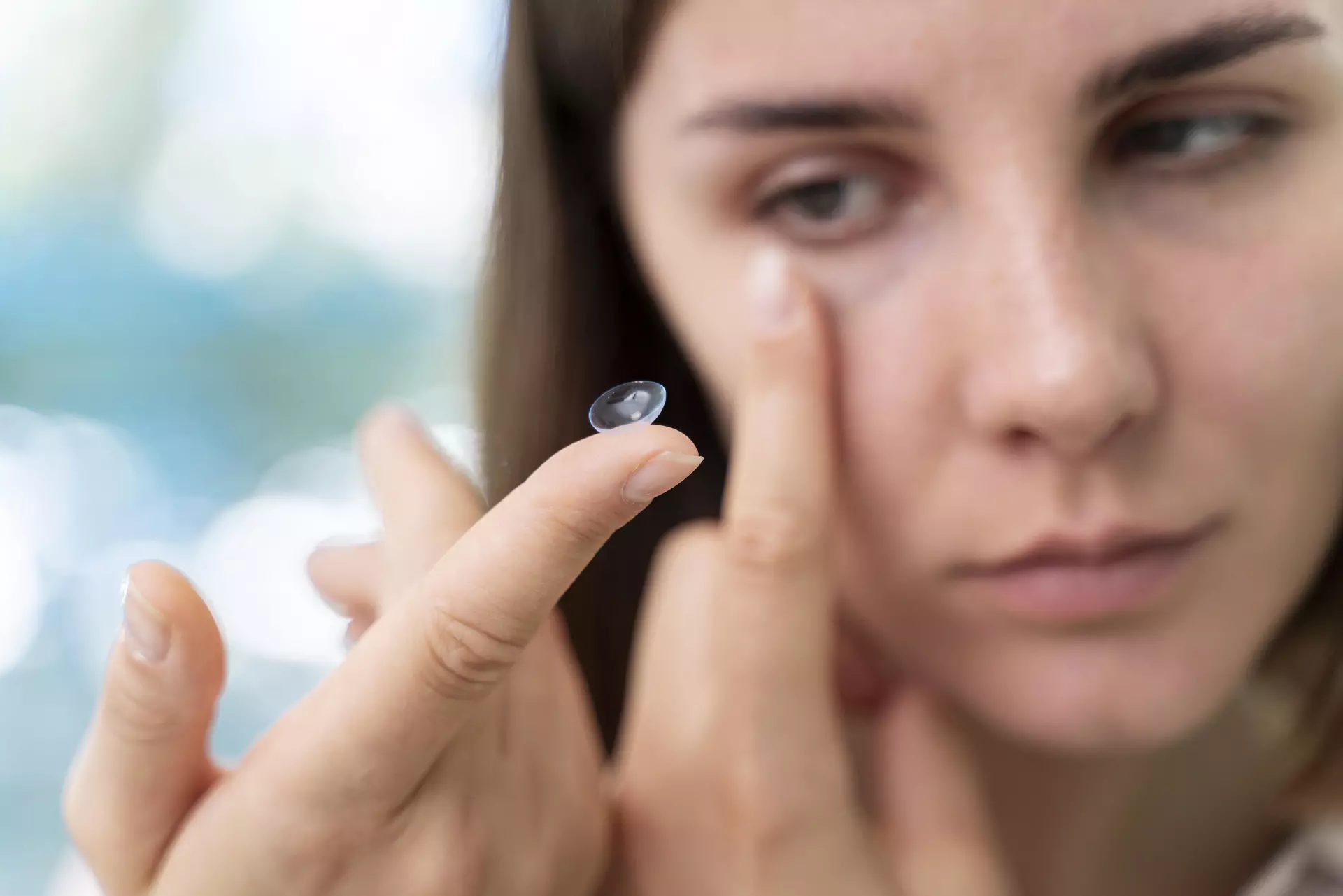
Contact lenses aren’t always a straightforward option for everyone with vision challenges. Certain eye conditions can make wearing contacts tricky. But that doesn’t mean contact lenses are off the table. It means you should chat with your trusted eye care provider to explore specialized hard to fit contacts tailored to your unique needs.
Request an AppointmentCommon Reasons for Hard to Fit Contact Lenses
Wearing contact lenses can be more complicated when your eyes are affected by specific conditions, such as:
- Astigmatism
- Dry eyes
- Giant Papillary Conjunctivitis (GPC)
- Keratoconus
- Presbyopia
Astigmatism: This occurs when the front surface of your eye curves irregularly into an oval or bulge shape, causing blurry vision. Regular contacts often can’t correct this bulge effectively.
Dry Eyes: When your eyes feel dry, irritated, or red, contacts can sometimes worsen the sensation, making it feel like something’s stuck in your eye.
GPC: This is an inflammation of the inner eyelid surface, often aggravated by protein deposits that build up on contact lenses.
Keratoconus: A less common condition where the cornea thins and bulges forward into a cone shape, making contact lens wear uncomfortable.
Presbyopia: As we age, especially past 40, focusing on close objects becomes more difficult due to this natural eye condition.
Effective Solutions for Hard to Fit Contacts
Even if you have one of these conditions, wearing contacts is still possible with the right approach. Meeting with an experienced eye care professional is essential to get lenses designed just for you.
Gas permeable (GP) lenses are often recommended for patients with GPC or Keratoconus. These lenses reduce protein buildup, easing GPC symptoms, and help support the cornea’s shape for those with Keratoconus.
Toric lenses are specially made to correct astigmatism by fitting the lens precisely to the eye’s bulge. These custom lenses prevent rotation to maintain clear vision but do require a longer fitting process and higher cost.
For presbyopia, bifocal and multifocal contact lenses can provide clear vision at different distances. Monovision lenses, where one eye is corrected for distance and the other for near vision, are another popular option.
Medicated eye drops can alleviate dry eye symptoms by lubricating your eyes, making contacts more comfortable. In some severe cases, punctal plugs may be necessary to keep moisture in. Medicated drops also help reduce inflammation and flush protein deposits for GPC sufferers.
Request an Appointment